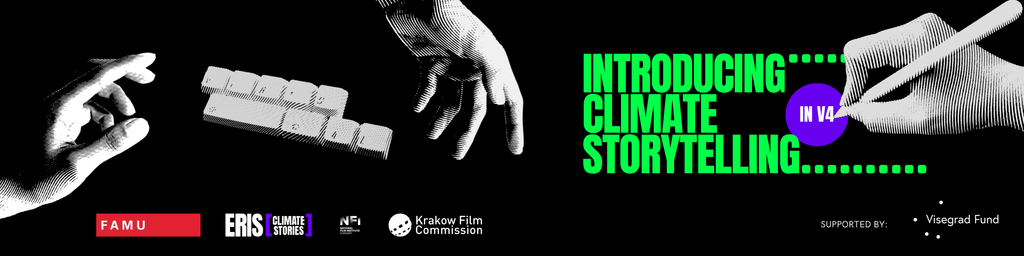
What stories do we tell in a changing climate?
25–26 November 2026 | Prague, Czechia | In English
A two-day international training and networking programme bringing together film and media students, professionals, educators and researchers from Czechia, Hungary, Poland and Slovakia to explore climate storytelling and sustainable audiovisual practice.
Applications are now open!
🌍 About the event
Climate change is transforming the world around us. What does that mean for the stories we tell?
Introducing Climate Storytelling in V4 brings together 40 participants from across the Visegrad region for two intensive days of learning, experimenting and exchanging perspectives in Prague. Together, we will explore how climate, nature and environmental change can become part of contemporary film and television storytelling – through characters, conflicts, settings, genres and the worlds we create on screen.
A story does not need to be about climate change to exist in a climate-changed world. Climate reality can influence where our characters live, how they move, what they eat, what they fear, what they work for, the conflicts they face and the futures they imagine.
The programme combines practical workshops, expert sessions, case studies, a V4 industry round table and networking, connecting creative approaches to storytelling with the wider transformation towards a more environmentally responsible audiovisual sector.
✍️ What to expect
Practical exercises and a dedicated writing workshop
Explore climate storytelling through writing, dramaturgy, characters, dramatic situations, plot and genre.
Lectures with international expertise
Learn from screenwriters, filmmakers, trainers and script consultants working directly with climate, nature and environmental storytelling.
Stories for a changing world
Explore how environmental crises and transitions can influence contemporary narratives without every story having to become a conventional “climate story”.
V4 industry perspectives
Discover how organisations and film institutions in Czechia, Hungary, Poland and Slovakia are approaching sustainable audiovisual production, industry standards, funding, education and climate storytelling.
Networking and exchange
Meet students, filmmakers, educators and audiovisual professionals from across the Visegrad region and exchange experiences across disciplines and borders.
🎤 Meet the experts
Fernanda Polacow
Screenwriter · Director · Script Consultant
Fernanda Polacow is a screenwriter, director and script consultant. Born and raised in Brazil and currently based in Lisbon, she specialises in writing and consulting for films in which climate and nature play a central role in the dramaturgy. She is a script tutor for Torino ScriptLab Green Narratives and a consultant for Netflix. As a writer, her films have screened at festivals including Rotterdam, Tallinn Black Nights, Mar del Plata, Guadalajara, Rio de Janeiro and IndieLisboa. Her latest work, a hybrid feature film to be released in December 2026, has been nominated for Best Script at the prestigious Panda Awards – Wildscreen Festival, one of the world’s leading festivals for nature and wildlife films.
Fernanda’s masterclass on will give participants an understanding of real-life examples of screenwriting with a climate lens.
Lucie Trémolières
Writer · Performer · Trainer · Script Consultant
Lucie Trémolières is a Paris-based writer, performer, trainer and script consultant working on how environmental crises and transitions impact the stories we tell. She has led trainings for French and European institutions including La Fémis, Climate Spring, Series Mania Institute and TorinoFilmLab, and is a consultant in Sustainability and Storytelling for Netflix. She works regularly with Ecoprod, for whom she co-wrote the Guide for Screenwriters and Development Professionals. As a writer and performer, she specialises in animation, comedy and clowning.
Lucie will present a keynote on climate storytelling from script to screen and share her experience as a script consultant and climate storytelling trainer.
Andrea Culková
Filmmaker · Researcher · Educator
Andrea Culková is a film director, researcher, and „social surgeon“ whose work explores social dysfunction, injustice, and the climate crisis (Sugar Blues, Don’t Take My Life, Grief). These themes led her to alternatives in political imagination – both through film and her doctoral research. Since 2019, she has worked with Citizens’ Assemblies, collaborating internationally and training the public, local governments, and future coordinators. She co-founded and co-leads the Platform for Citizens’ Assemblies in the Czech Republic. Andrea is finalizing the feature film Dear People, Dear Citizens, which follows Europe reclaiming its ancient democratic roots through sortition – informed, randomly selected citizens making decisions (www.dearpeople.eu). She teaches Climate Storytelling to FAMU and FHS UK students. As a member of ARAS, she has actively participated in sustainability advocacy within the Czech film industry.
She will lead a practical workshop exploring climate, collapse, political systems and storytelling.
🎬 Programme Structure
🌱 Keynote: Green Storytelling from Script to Screen
Lucie Trémolières
📺 Case Study: Scripted TV & Climate Storytelling
Fernanda Polacow
✍️ Writing Workshop: Storytelling in Times of Crisis
Andrea Culková
💬 Mentorship Clinic for Climate Stories
The program includes a mentorship clinic with all our experts – Lucie, Fernanda and Andrea, and it focuses exclusively on audiovisual projects at an outline or treatment stage (scripts will not be considered). If you have a project you wish to consult and receive mentoring on, make sure to fill in the relevant part of the open call. To foster dynamic, personalized learning and networking, participants will engage in multiple short, focused “clinic” sessions, rotating every 20-30 minutes among expert mentors. This format maximizes exposure to diverse expert insights within a condensed timeframe, allowing participants to receive tailored, actionable feedback on their projects from multiple perspectives. The interactive, fast-paced clinics encourage active dialogue, peer learning, and relationship-building, creating a supportive mentorship network that extends beyond the event. By facilitating direct connections between emerging talents and seasoned professionals, the Mentorship Circles will strengthen participants’ creative and technical skills, deepen their understanding of sustainability in media, and inspire collaborative projects that advance green storytelling across the V4 region.
Lucie Trémolières, Fernanda Polacow, Andrea Culková
🌍 V4 Round Table
What is already changing across the V4 audiovisual industry? Representatives from Czechia, Hungary, Poland and Slovakia will come together to share what is already happening in their respective countries and discuss approaches to sustainable production, film funding, industry standards, education and climate storytelling. The round table creates an opportunity to compare different V4 experiences and ask what we can learn from one another instead of developing solutions in isolation.
🇨🇿 Miroslav Vlček | Czechia, Platform for Sustainable Audiovisual Production – PUAV 🇭🇺 Eszter Lányi | Hungary, National Film Institute of Hungary 🇵🇱 Anna Krupiarz | Poland, Krakow Film Commission 🇸🇰 Zuzana Bieliková | Slovakia, Slovak Film Commission (SFC) · ERIS [Climate Stories]
👀 Who should apply?
You don’t need to be a climate expert.
The open call is intended for applicants based in Czechia, Hungary, Poland and Slovakia, particularly:
🎓 Film and media students – including screenwriting, directing, production, documentary, animation and related disciplines
🎬 Film and media professionals – particularly screenwriters, directors and producers
📚 Film and media educators and researchers
Previous experience with climate storytelling or sustainable filmmaking is not required. We are interested in participants who are curious about how environmental and social change can influence the stories we tell and the ways in which audiovisual works are created.
Selected participants are expected to attend the full two-day programme on 25–26 November 2026.
📍 Practical information
📅 WHEN
25–26 November 2026
📍 WHERE
Prague, Czechia – Studio FAMU
🗣️ WORKING LANGUAGE
English
🎟️ PARTICIPATION
Participation is free of charge for selected participants.
🥗 MEALS
Meals and refreshments during both programme days are provided.
🏨 ACCOMMODATION
Two nights of accommodation in Prague will be covered for up to 30 eligible selected participants. Accommodation is available to selected participants whose journey from their place of residence to Prague takes more than two hours. This condition applies regardless of which V4 country the participant comes from, including participants based in Czechia.
🚆 TRAVEL
Participants are responsible for arranging and covering their own travel costs to and from Prague.
📝 Open Call
Ready to join us?
We are looking for 40 participants from across Czechia, Hungary, Poland and Slovakia who want to explore what climate storytelling can mean for contemporary film and television.
You do not need previous professional experience with climate storytelling. We are interested in your motivation, creative or professional perspective, and curiosity about the subject.
Application deadline: October 31st 2026, midnight CEST
Applicants will be informed of the results by: November 6th 2026
❓ Frequently Asked Questions
Do I need previous experience with climate storytelling?
No. Previous experience is not required. The programme is suitable both for people already exploring these questions and for those approaching climate storytelling for the first time.
Do I need to have my own film or television project?
No. You do not need to have a project in development in order to apply. If you have one (or an idea for one) you are welcome to consult on it during the mentorship sessions with our experts on Day 2.
Is participation free?
Yes. There is no participation fee for participants.
Is accommodation provided?
Two nights of accommodation in Prague will be covered for up to 30 eligible selected participants whose journey from their place of residence to Prague takes more than two hours.
I live in Czechia. Can I still receive accommodation?
Yes. Accommodation eligibility is based on travel time from your place of residence, not on crossing a national border.
Are travel costs covered?
No. Participants are responsible for arranging and covering their own travel to and from Prague.
Are meals provided?
Meals and refreshments during the two programme days are provided.
What language will the programme be in?
The working language of the event is English.
Do I need to attend both days?
Yes. Selected participants are expected to participate in the full programme on 25–26 November.
Who can apply?
The open call is aimed at film and media students, professionals, educators and researchers based in Czechia, Hungary, Poland and Slovakia.
When will I know whether I have been selected?
Applicants will be informed by 6th of November 2026.
Have another question?
Contact us at info@erisclimatestories.org and eris.climate.stories@gmail.com
🤝 About the project
Introducing Climate Storytelling in V4 connects audiovisual education and professional practice across the Visegrad region.
By bringing together climate storytelling and sustainable filmmaking, the project looks at both sides of audiovisual transformation: the stories we put on screen and the ways in which we create them.
The programme creates a space for filmmakers, students, educators, institutions and sustainability initiatives from across the V4 to exchange knowledge, discover approaches from other European contexts and build stronger regional connections.
🎬 4 countries · 40+ participants · 2 days · Prague
👉 APPLY FOR INTRODUCING CLIMATE STORYTELLING IN V4
The project is co-financed by the governments of Czechia, Hungary, Poland and Slovakia through Visegrad Grants from the International Visegrad Fund. The mission of the fund is to advance ideas for sustainable regional cooperation in Central Europe.


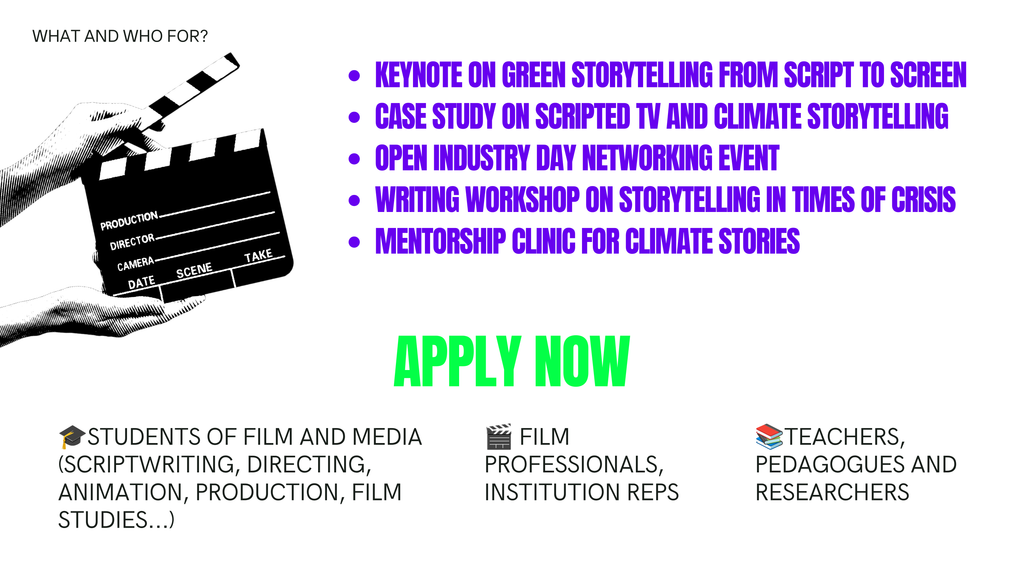
Program of the 2-day event “Introducing Climate Storytelling in Visegrad” consists of:
Roundtable on Introduction to existing V4 practices and situation
Keynote on Green storytelling from script to screen
Open Industry Day with a networking soireé
Case study on Scripted TV and climate storytelling
Writing workshop on Storytelling in times of crisis
Mentorship clinic for climate stories